Filters
Question type

Solve. -In 1985, the number of female athletes participating in Summer Olympic-Type Games was 450. In 1996, about 3650 participated in the Summer Olympics in Atlanta. Assuming that P(0) = 500 and That the exponential model applies, find the value of k rounded to the hundredths place, and write The function.


A) k=0.19;P(t) =500e0.29t\mathrm { k } = 0.19 ; \mathrm { P } ( \mathrm { t } ) = 500 \mathrm { e } ^ { 0.29 \mathrm { t } }
B) k=0.17;P(t) =500e0.17t\mathrm { k } = 0.17 ; \mathrm { P } ( \mathrm { t } ) = 500 \mathrm { e } ^ { 0.17 \mathrm { t } }
C) k=0.19;P(t) =500e0.19t\mathrm { k } = 0.19 ; \mathrm { P } ( \mathrm { t } ) = 500 \mathrm { e } ^ { 0.19 \mathrm { t } }
D) k=0.21;P(t) =500e0.21t\mathrm { k } = 0.21 ; \mathrm { P } ( \mathrm { t } ) = 500 \mathrm { e } ^ { 0.21 \mathrm { t } }

E) A) and B)
F) A) and C)

Correct Answer

verifed

verified

Solve. -Suppose that $11,000 is invested at an interest rate of 5.8% per year, compounded continuously. What is the doubling time?


A) 11 yr
B) 13 yr
C) 2 yr
D) 12 yr

E) A) and B)
F) None of the above

Correct Answer

verifed

verified

For the function f, use composition of functions to show that f f1 is as given. \mathrm { f } ^ { - 1 } \text { is as given. } - f(x)=x34,f1(x)=x+43f ( x ) = x ^ { 3 } - 4 , f ^ { - 1 } ( x ) = \sqrt [ 3 ] { x + 4 }

Correct Answer

verifed

verified

Answers may vary. One possible solution is: 1. \(\left( \mathrm { f } ^ { - 1 } \circ \mathrm { f } \right) ( \mathrm { x } ) = \mathrm { f } ^ { - 1 } ( \mathrm { f } ( \mathrm { x } ) ) = \mathrm { f } ^ { - 1 } \left( \mathrm { x } ^ { 3 } - 4 \right) = \sqrt [ 3 ] { \left( \mathrm { x } ^ { 3 } - 4 \right) + 4 } = \sqrt [ 3 ] { \mathrm { x } ^ { 3 } } = \mathrm { x }\); 2. \(\left( f \circ f ^ { - 1 } \right) ( x ) = f \left( f ^ { - 1 } ( x ) \right) = \left\{ ( \sqrt [ 3 ] { x + 4 } ) = ( \sqrt [ 3 ] { x + 4 } ) ^ { 3 } - 4 = x + 4 - 4 = x \right.\)

Find the value of the expression. - log5625\log _ { 5 } 625


A) 625
B) 20
C) 5
D) 4

E) B) and C)
F) None of the above

Correct Answer

verifed

verified

Find the logarithm using the change-of-base formula. - log60.196\log _ { 6 } 0.196


A) 0.9095- 0.9095
B) 1.0995- 1.0995
C) 30.612230.6122
D) 0.7077- 0.7077

E) B) and D)
F) B) and C)

Correct Answer

verifed

verified

Solve the problem. -An initial investment of $480 is appreciated for 3 years in an account that earns 13% interest, compounded quarterly. Find the amount of money in the account at the end of the period.


A) $704.57
B) $682.39
C) $224.57
D) $692.59

E) B) and C)
F) A) and B)

Correct Answer

verifed

verified

A

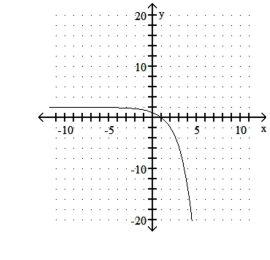
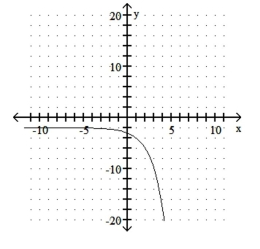
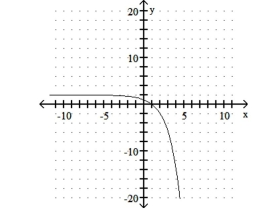
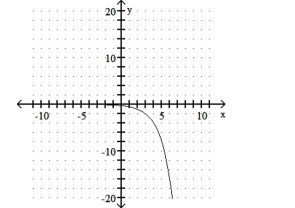
Sketch the graph of the function. Describe how the graph can be obtained from the graph of a basic exponential function. - f(x) =2(x2) f(x) =-2(x-2)  Sketch the graph of the function. Describe how the graph can be obtained from the graph of a basic exponential function. - f(x) =-2(x-2)      A)  Shift  y = 2 ^ { x }  left 2 unit(s)  and reflect  across the  x -axis   B)  Reflect  y = 2 ^ { x }  and across the  x -axis    C)  Reflect  y = 2 ^ { x }  across the  x -axis and shift up 2 unit(s)    D)  Shift  y = 2 ^ { x }  right 2 unit(s)  and reflect across the the  x -axis


A) Shift y=2xy = 2 ^ { x } left 2 unit(s) and reflect across the xx -axis
 Sketch the graph of the function. Describe how the graph can be obtained from the graph of a basic exponential function. - f(x) =-2(x-2)      A)  Shift  y = 2 ^ { x }  left 2 unit(s)  and reflect  across the  x -axis   B)  Reflect  y = 2 ^ { x }  and across the  x -axis    C)  Reflect  y = 2 ^ { x }  across the  x -axis and shift up 2 unit(s)    D)  Shift  y = 2 ^ { x }  right 2 unit(s)  and reflect across the the  x -axis
B) Reflect y=2xy = 2 ^ { x } and across the xx -axis
 Sketch the graph of the function. Describe how the graph can be obtained from the graph of a basic exponential function. - f(x) =-2(x-2)      A)  Shift  y = 2 ^ { x }  left 2 unit(s)  and reflect  across the  x -axis   B)  Reflect  y = 2 ^ { x }  and across the  x -axis    C)  Reflect  y = 2 ^ { x }  across the  x -axis and shift up 2 unit(s)    D)  Shift  y = 2 ^ { x }  right 2 unit(s)  and reflect across the the  x -axis
C) Reflect y=2xy = 2 ^ { x } across the xx -axis and shift up 2 unit(s)
 Sketch the graph of the function. Describe how the graph can be obtained from the graph of a basic exponential function. - f(x) =-2(x-2)      A)  Shift  y = 2 ^ { x }  left 2 unit(s)  and reflect  across the  x -axis   B)  Reflect  y = 2 ^ { x }  and across the  x -axis    C)  Reflect  y = 2 ^ { x }  across the  x -axis and shift up 2 unit(s)    D)  Shift  y = 2 ^ { x }  right 2 unit(s)  and reflect across the the  x -axis
D) Shift y=2xy = 2 ^ { x } right 2 unit(s) and reflect across the the xx -axis
 Sketch the graph of the function. Describe how the graph can be obtained from the graph of a basic exponential function. - f(x) =-2(x-2)      A)  Shift  y = 2 ^ { x }  left 2 unit(s)  and reflect  across the  x -axis   B)  Reflect  y = 2 ^ { x }  and across the  x -axis    C)  Reflect  y = 2 ^ { x }  across the  x -axis and shift up 2 unit(s)    D)  Shift  y = 2 ^ { x }  right 2 unit(s)  and reflect across the the  x -axis

E) None of the above
F) A) and B)

Correct Answer

verifed

verified

D

Solve. -In 1998 , the population of Country C was 26 million, and the exponential growth rate was 1%1 \% per year. Find the exponential growth function.


A) P(t) =26e1t\mathrm { P } ( \mathrm { t } ) = 26 \mathrm { e } ^ { 1 \mathrm { t } } , where P(t) \mathrm { P } ( \mathrm { t } ) is in millions and t\mathrm { t } is the number of years after 1998 .
B) P(t) =26e0.01\mathrm { P } ( \mathrm { t } ) = 26 \mathrm { e } ^ { 0.01 } , where P(t) \mathrm { P } ( \mathrm { t } ) is in millions and t\mathrm { t } is the number of years after 1998 .
C) P(t) =260.01t\mathrm { P } ( \mathrm { t } ) = 26 ^ { 0.01 \mathrm { t } } , where P(t) \mathrm { P } ( \mathrm { t } ) is in millions and tt is the number of years after 1998 .
D) P(t) =26e0.01tP ( t ) = 26 e ^ { 0.01 t } , where P(t) P ( t ) is in millions and tt is the number of years after 1998 .

E) None of the above
F) B) and D)

Correct Answer

verifed

verified

Provide an appropriate response. -Prove that the function f is one-to-one. f(x)=612xf ( x ) = 6 - \frac { 1 } { 2 } x

Correct Answer

verifed

verified

Assume that blured image for any numbers blured image and blured image in th...

View Answer

Solve the logarithmic equation. - log16x=12\log _ { 16 } x = \frac { 1 } { 2 }


A) 0.000015260.00001526
B) 256
C) 65,536
D) 4

E) All of the above
F) A) and D)

Correct Answer

verifed

verified

Provide an appropriate response. -The product, power, and quotient rules enable us to simplify expressions like loga(rspv)\log _ { \mathrm { a } } \left( \frac { \mathrm { rs } } { \mathrm { pv } } \right) . Explain why such expressions can always be simplified without using the quotient rule.

Correct Answer

verifed

verified

Solve the problem. -Suppose the amount of a radioactive element remaining in a sample of 100 milligrams after xx years can be described by A(x) =100e0.01569x\mathrm { A } ( \mathrm { x } ) = 100 \mathrm { e } ^ { - 0.01569 \mathrm { x } } . How much is remaining after 58 years? Round the answer to the nearest hundredth of a milligram.


A) 0.40mg0.40 \mathrm { mg }
B) 248.44mg248.44 \mathrm { mg }
C) 91.00mg91.00 \mathrm { mg }
D) 40.25mg40.25 \mathrm { mg }

E) None of the above
F) A) and B)

Correct Answer

verifed

verified

Solve. -The population of a particular city is increasing at a rate proportional to its size. It follows the function P(t) =1+ke0.12t\mathrm { P } ( \mathrm { t } ) = 1 + \mathrm { ke } ^ { 0.12 \mathrm { t } } where k\mathrm { k } is a constant and t\mathrm { t } is the time in years. If the current population is 50,000 , in how many years is the population expected to be 125,000 ? (Round to the nearest year.)


A) 8yr8 \mathrm { yr }
B) 3yr3 \mathrm { yr }
C) 60yr60 \mathrm { yr }
D) 5yr5 \mathrm { yr }

E) A) and C)
F) B) and D)

Correct Answer

verifed

verified

Provide an appropriate response. -Explain the error in the following: log43y=log43log4y\log _ { 4 } 3 y = \log _ { 4 } 3 \cdot \log _ { 4 } y

Correct Answer

verifed

verified

Sketch the graph of the function. Describe how the graph can be obtained from the graph of a basic logarithmic function. - f(x) =14log(x+2) +4f ( x ) = \frac { 1 } { 4 } \log ( x + 2 ) + 4  Sketch the graph of the function. Describe how the graph can be obtained from the graph of a basic logarithmic function. - f ( x )  = \frac { 1 } { 4 } \log ( x + 2 )  + 4    A)  Shift  y = \log x  to the left 2 units,  stretch it vertically, and shift up 4 units    B)  Shift  y = \log x  to the right 2 units ,shrink it vertically, and shift up 4 units   C)  Shift  y = \log x  to the left 2 units, shrink it vertically, and shift down 4 units    D)  Shift  y = \log x  to the left 2 units,  shrink it vertically, and shift up 4 units
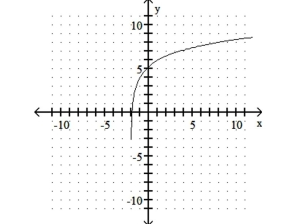
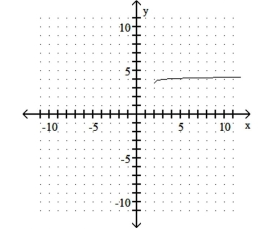
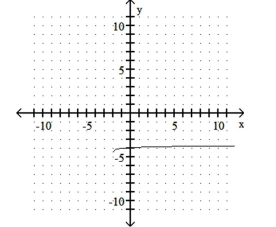
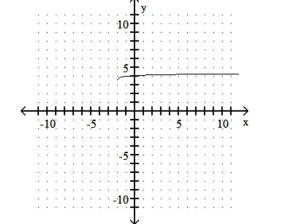

A) Shift y=logxy = \log x to the left 2 units,
stretch it vertically, and shift up 4 units
 Sketch the graph of the function. Describe how the graph can be obtained from the graph of a basic logarithmic function. - f ( x )  = \frac { 1 } { 4 } \log ( x + 2 )  + 4    A)  Shift  y = \log x  to the left 2 units,  stretch it vertically, and shift up 4 units    B)  Shift  y = \log x  to the right 2 units ,shrink it vertically, and shift up 4 units   C)  Shift  y = \log x  to the left 2 units, shrink it vertically, and shift down 4 units    D)  Shift  y = \log x  to the left 2 units,  shrink it vertically, and shift up 4 units
B) Shift y=logxy = \log x to the right 2 units
,shrink it vertically, and shift up 4 units
 Sketch the graph of the function. Describe how the graph can be obtained from the graph of a basic logarithmic function. - f ( x )  = \frac { 1 } { 4 } \log ( x + 2 )  + 4    A)  Shift  y = \log x  to the left 2 units,  stretch it vertically, and shift up 4 units    B)  Shift  y = \log x  to the right 2 units ,shrink it vertically, and shift up 4 units   C)  Shift  y = \log x  to the left 2 units, shrink it vertically, and shift down 4 units    D)  Shift  y = \log x  to the left 2 units,  shrink it vertically, and shift up 4 units
C) Shift y=logxy = \log x to the left 2 units,
shrink it vertically, and shift down 4 units
 Sketch the graph of the function. Describe how the graph can be obtained from the graph of a basic logarithmic function. - f ( x )  = \frac { 1 } { 4 } \log ( x + 2 )  + 4    A)  Shift  y = \log x  to the left 2 units,  stretch it vertically, and shift up 4 units    B)  Shift  y = \log x  to the right 2 units ,shrink it vertically, and shift up 4 units   C)  Shift  y = \log x  to the left 2 units, shrink it vertically, and shift down 4 units    D)  Shift  y = \log x  to the left 2 units,  shrink it vertically, and shift up 4 units
D) Shift y=logxy = \log x to the left 2 units,
shrink it vertically, and shift up 4 units
 Sketch the graph of the function. Describe how the graph can be obtained from the graph of a basic logarithmic function. - f ( x )  = \frac { 1 } { 4 } \log ( x + 2 )  + 4    A)  Shift  y = \log x  to the left 2 units,  stretch it vertically, and shift up 4 units    B)  Shift  y = \log x  to the right 2 units ,shrink it vertically, and shift up 4 units   C)  Shift  y = \log x  to the left 2 units, shrink it vertically, and shift down 4 units    D)  Shift  y = \log x  to the left 2 units,  shrink it vertically, and shift up 4 units

E) C) and D)
F) A) and B)

Correct Answer

verifed

verified

Choose the function that might be used as a model for the data in the scatter plot. - Choose the function that might be used as a model for the data in the scatter plot. -  A)  Logarithmic,  f ( x )  = a + b \ln x  B)  Exponential,  \mathrm { f } ( \mathrm { x } )  = \mathrm { ab } ^ { \mathrm { x } }  or  \mathrm { f } ( \mathrm { x } )  = \mathrm { P } _ { 0 } \mathrm { e } ^ { \mathrm { kx } } , \mathrm { k } > 0  C)  Quadratic,  f ( x )  = a x ^ { 2 } + b x + c  D)  Exponential,  \mathrm { f } ( \mathrm { x } )  = \mathrm { ab } ^ { - \mathrm { x } }  or  \mathrm { f } ( \mathrm { x } )  = \mathrm { P } _ { 0 } \mathrm { e } ^ { - \mathrm { kx } } , \mathrm { k } > 0


A) Logarithmic, f(x) =a+blnxf ( x ) = a + b \ln x
B) Exponential, f(x) =abx\mathrm { f } ( \mathrm { x } ) = \mathrm { ab } ^ { \mathrm { x } } or f(x) =P0ekx,k>0\mathrm { f } ( \mathrm { x } ) = \mathrm { P } _ { 0 } \mathrm { e } ^ { \mathrm { kx } } , \mathrm { k } > 0
C) Quadratic, f(x) =ax2+bx+cf ( x ) = a x ^ { 2 } + b x + c
D) Exponential, f(x) =abx\mathrm { f } ( \mathrm { x } ) = \mathrm { ab } ^ { - \mathrm { x } } or f(x) =P0ekx,k>0\mathrm { f } ( \mathrm { x } ) = \mathrm { P } _ { 0 } \mathrm { e } ^ { - \mathrm { kx } } , \mathrm { k } > 0

E) All of the above
F) A) and D)

Correct Answer

verifed

verified

Provide an appropriate response. -Prove that the function f is not one-to-one. f(x)=2x6f ( x ) = \frac { 2 } { x ^ { 6 } }

Correct Answer

verifed

verified

Answers may vary. Possible ans...

View Answer

Solve the logarithmic equation. - log3(8x6) =3\log _ { 3 } ( 8 x - 6 ) = 3


A) log33+68\frac { \log _ { 3 } 3 + 6 } { 8 }
B) 113\frac { 11 } { 3 }
C) 338\frac { 33 } { 8 }
D) 25

E) A) and D)
F) All of the above

Correct Answer

verifed

verified

For the function f, use composition of functions to show that f f1 is as given. \mathrm { f } ^ { - 1 } \text { is as given. } - f(x)=53x,f1(x)=35xf ( x ) = - \frac { 5 } { 3 } x , f ^ { - 1 } ( x ) = - \frac { 3 } { 5 } x

Correct Answer

verifed

verified

Answers may vary. On...

View Answer

For the function f, use composition of functions to show that f f1 is as given. \mathrm { f } ^ { - 1 } \text { is as given. } - f(x)=x+46,f1(x)=6x4f ( x ) = \frac { x + 4 } { 6 } , f ^ { - 1 } ( x ) = 6 x - 4

Correct Answer

verifed

verified

Answers may vary. On...

View Answer

Showing 1 - 20 of 106

Related Exams

Show Answer